
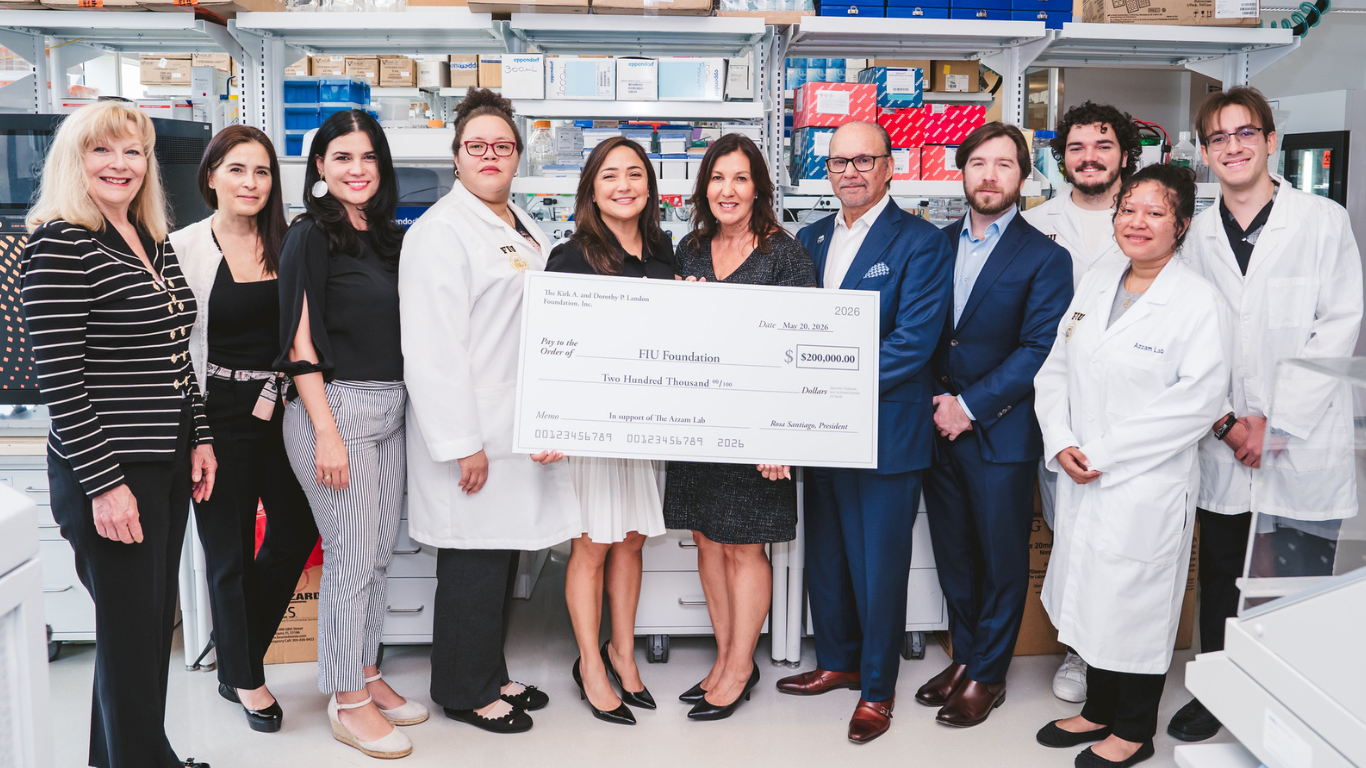
A personalized approach to cancer treatment being advanced at FIU is moving closer to clinical use, supported by philanthropic investment aimed at helping researchers translate promising laboratory science into tools that may one day guide patient care.
The Kirk A. and Dorothy P. Landon Foundation has made two gifts of $100,000 each, in December 2024 and January 2026, to support research led by Diana Azzam and the needs of the Azzam lab. The funds are helping advance the validation of a novel drug sensitivity test and resources needed as the lab works toward CLIA certification, a key milestone in translating the platform from research into clinical trials and, eventually, routine cancer care.
Azzam’s lab is pioneering functional precision medicine, an approach that tests living tumor cells from individual patients against large libraries of drugs to determine which therapies may be most effective for that person’s cancer. The goal is to translate the laboratory-based test into a validated clinical tool that can be used in interventional clinical trials and, eventually, routine cancer care.
“Functional precision medicine allows us to ask a very direct question: which treatments are most likely to work for this patient’s cancer?” Azzam said. “CLIA certification would be an important step in bringing that information closer to the point of care.”
The Landon Foundation’s support comes amid growing philanthropic investment in Azzam’s work. Earlier this year, a gift from the Tyler Trent Foundation helped expand the lab’s library of FDA-approved generic medications and natural compounds being studied for potential use in recurrent and treatment-resistant cancers.
The Landon Foundation gift focuses on a different but equally important part of the process: building the infrastructure needed to move the test from a research setting toward broader clinical application.
“For patients and families facing difficult cancer diagnoses, the search for more effective treatment options is deeply personal,” said Rosa Santiago of The Kirk A. and Dorothy P. Landon Foundation. “The Foundation is proud to support Dr. Azzam’s efforts to move this promising research closer to clinical application and, ultimately, closer to the people who need it most.”
To achieve CLIA certification, the Azzam lab must show that its test can produce reliable, reproducible results that may help inform clinical decisions. The lab has made significant progress toward that milestone, completing precision and accuracy testing for more than 100 drugs and drug combinations. Validation using hematological cancer datasets is close to completion, while testing in solid cancers is well underway. Once achieved, CLIA certification would open the door to interventional clinical trials, including studies evaluating this approach in newly diagnosed cancer patients.
For many patients with aggressive or recurrent cancers, genomic testing alone does not always identify an actionable treatment. By directly measuring how tumor cells respond to different therapies, functional precision medicine may offer another path to identify options that might otherwise be missed.
“This kind of philanthropic support is critical because it helps us build the foundation required to translate discovery into patient care,” Azzam said. “It brings us closer to making this type of testing available not only for patients with relapsed and refractory cancers, but also earlier in the disease course for newly diagnosed patients.”